Frames
Finding the Perfect Frame
A frame isn’t just a border — it’s the finishing touch that brings your artwork and your space into conversation with each other. The right frame can elevate a print, complement a room, and turn something you love into something you’ll treasure for decades.
Here’s a guide to our framing options, so you can choose with confidence.
Step 1: Choose Your Frame Style
The mould is the physical border of the frame — its width, depth, and finish. Think of it as the frame’s personality.
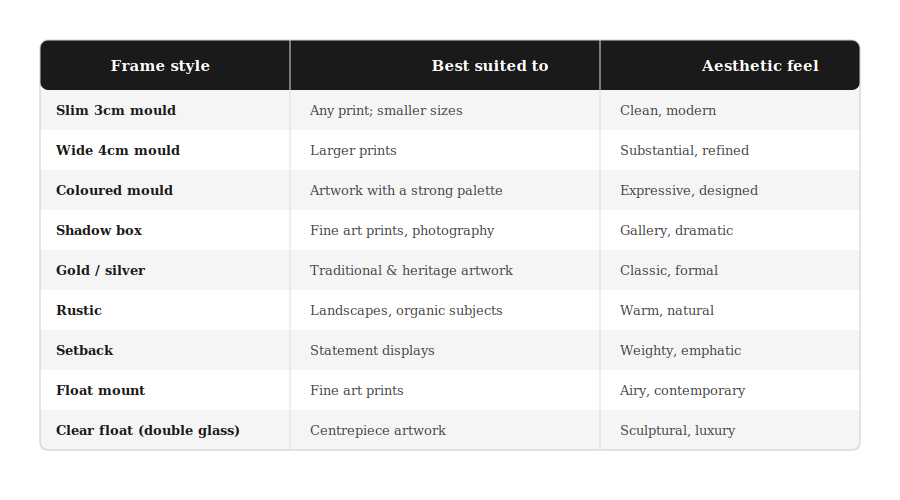
Slim (3cm) Mould — Clean, minimal, and understated. Lets the artwork lead. Works with almost any interior, particularly contemporary and Scandinavian-style spaces.
Wide (4cm) Mould — Slightly more substantial, lending visual weight and presence. Suits larger prints and spaces where the frame itself is part of the statement.
Coloured Moulds — Available in both 3cm and 4cm widths. A coloured frame can tie an artwork to the palette of a room, or create a deliberate, striking contrast. Great for maximalist interiors or as a considered design choice.
Shadow Box — A deeper, recessed frame that creates a subtle shadow between the artwork and the glass. The effect adds dimension and a gallery-exhibition quality to the piece. Works beautifully in formal living spaces, studios, and anywhere you want the artwork to feel set apart from its surroundings.
Gold / Silver — Timeless metal-finish moulds with a heritage feel. Ideal for traditional artwork, portraiture, botanicals, and interiors that draw on classic or eclectic influences.
Rustic — A natural wood-grain finish with warmth and texture. Suits landscapes, earthy-toned artwork, and homes with a relaxed, organic, or farmhouse aesthetic.
Step 2: Mat or No Mat?
A mat is the border of board that sits between the artwork and the frame edge, creating a margin of breathing room around the print.
No Mat — The artwork fills the full frame. Graphic and bold; works particularly well with photography and artwork that has strong edges or a full-bleed composition.
Standard Mat (5cm) — A 5cm border of acid-free matboard frames the artwork within the frame. This is the classic gallery presentation. It draws the eye to the artwork, gives the piece a sense of importance, and suits almost any style — particularly fine art paper prints. If you’re unsure, this is the option we’d recommend.
Step 3: Consider the Presentation Style
Beyond the mould and mat, we offer a few distinctive presentation styles that change how the artwork sits within the frame:
Setback — The artwork is recessed a little further behind the glass, creating a deeper shadow and a more emphatic sense of the artwork being held within the frame. A subtle but effective way to add gravitas to a piece. Available in Shadow Box and Rustic finishes.
Float Mount — Rather than sitting flush, the artwork appears to float in the centre of the frame with visible space on all sides. This is a contemporary gallery technique that gives artwork a light, suspended quality — especially striking with fine art prints. Available in Shadow Box and Rustic finishes.
Clear Float (Double Glass) — The most architectural option we offer. The artwork is suspended between two panes of glass, front and back, so light passes through the frame from all angles. The result is a sculptural, jewel-like presentation that makes the artwork feel almost three-dimensional. Suited to statement pieces in well-lit rooms. Not available for the very largest sizes.
Step 1: Choose Your Frame Style
The mould is the physical border of the frame — its width, depth, and finish. Think of it as the frame’s personality.
Slim (3cm) Mould — Clean, minimal, and understated. Lets the artwork lead. Works with almost any interior, particularly contemporary and Scandinavian-style spaces.
Wide (4cm) Mould — Slightly more substantial, lending visual weight and presence. Suits larger prints and spaces where the frame itself is part of the statement.
Coloured Moulds — Available in both 3cm and 4cm widths. A coloured frame can tie an artwork to the palette of a room, or create a deliberate, striking contrast. Great for maximalist interiors or as a considered design choice.
Shadow Box — A deeper, recessed frame that creates a subtle shadow between the artwork and the glass. The effect adds dimension and a gallery-exhibition quality to the piece. Works beautifully in formal living spaces, studios, and anywhere you want the artwork to feel set apart from its surroundings.
Gold / Silver — Timeless metal-finish moulds with a heritage feel. Ideal for traditional artwork, portraiture, botanicals, and interiors that draw on classic or eclectic influences.
Rustic — A natural wood-grain finish with warmth and texture. Suits landscapes, earthy-toned artwork, and homes with a relaxed, organic, or farmhouse aesthetic.
Step 3: Consider the Presentation Style
Beyond the mould and mat, we offer a few distinctive presentation styles that change how the artwork sits within the frame:
Setback — The artwork is recessed a little further behind the glass, creating a deeper shadow and a more emphatic sense of the artwork being held within the frame. A subtle but effective way to add gravitas to a piece. Available in Shadow Box and Rustic finishes.
Float Mount — Rather than sitting flush, the artwork appears to float in the centre of the frame with visible space on all sides. This is a contemporary gallery technique that gives artwork a light, suspended quality — especially striking with fine art prints. Available in Shadow Box and Rustic finishes.
Clear Float (Double Glass) — The most architectural option we offer. The artwork is suspended between two panes of glass, front and back, so light passes through the frame from all angles. The result is a sculptural, jewel-like presentation that makes the artwork feel almost three-dimensional. Suited to statement pieces in well-lit rooms. Not available for the very largest sizes.
Step 2: Mat or No Mat?
A mat is the border of board that sits between the artwork and the frame edge, creating a margin of breathing room around the print.
No Mat — The artwork fills the full frame. Graphic and bold; works particularly well with photography and artwork that has strong edges or a full-bleed composition.
Standard Mat (5cm) — A 5cm border of acid-free matboard frames the artwork within the frame. This is the classic gallery presentation. It draws the eye to the artwork, gives the piece a sense of importance, and suits almost any style — particularly fine art paper prints. If you’re unsure, this is the option we’d recommend.
Step 1: Choose Your Frame Style
The mould is the physical border of the frame — its width, depth, and finish. Think of it as the frame’s personality.
Slim (3cm) Mould — Clean, minimal, and understated. Lets the artwork lead. Works with almost any interior, particularly contemporary and Scandinavian-style spaces.
Wide (4cm) Mould — Slightly more substantial, lending visual weight and presence. Suits larger prints and spaces where the frame itself is part of the statement.
Coloured Moulds — Available in both 3cm and 4cm widths. A coloured frame can tie an artwork to the palette of a room, or create a deliberate, striking contrast. Great for maximalist interiors or as a considered design choice.
Shadow Box — A deeper, recessed frame that creates a subtle shadow between the artwork and the glass. The effect adds dimension and a gallery-exhibition quality to the piece. Works beautifully in formal living spaces, studios, and anywhere you want the artwork to feel set apart from its surroundings.
Gold / Silver — Timeless metal-finish moulds with a heritage feel. Ideal for traditional artwork, portraiture, botanicals, and interiors that draw on classic or eclectic influences.
Rustic — A natural wood-grain finish with warmth and texture. Suits landscapes, earthy-toned artwork, and homes with a relaxed, organic, or farmhouse aesthetic.
Step 2: Mat or No Mat?
A mat is the border of board that sits between the artwork and the frame edge, creating a margin of breathing room around the print.
No Mat — The artwork fills the full frame. Graphic and bold; works particularly well with photography and artwork that has strong edges or a full-bleed composition.
Standard Mat (5cm) — A 5cm border of acid-free matboard frames the artwork within the frame. This is the classic gallery presentation. It draws the eye to the artwork, gives the piece a sense of importance, and suits almost any style — particularly fine art paper prints. If you’re unsure, this is the option we’d recommend.
Step 3: Consider the Presentation Style
Beyond the mould and mat, we offer a few distinctive presentation styles that change how the artwork sits within the frame:
Setback — The artwork is recessed a little further behind the glass, creating a deeper shadow and a more emphatic sense of the artwork being held within the frame. A subtle but effective way to add gravitas to a piece. Available in Shadow Box and Rustic finishes.
Float Mount — Rather than sitting flush, the artwork appears to float in the centre of the frame with visible space on all sides. This is a contemporary gallery technique that gives artwork a light, suspended quality — especially striking with fine art prints. Available in Shadow Box and Rustic finishes.
Clear Float (Double Glass) — The most architectural option we offer. The artwork is suspended between two panes of glass, front and back, so light passes through the frame from all angles. The result is a sculptural, jewel-like presentation that makes the artwork feel almost three-dimensional. Suited to statement pieces in well-lit rooms. Not available for the very largest sizes.